
MANAGE YOUR COOKIE PREFERENCES

We use necessary cookies to make our site work and to give you the best possible experience. If you are happy for us to do so, we would also like to set optional analytics cookies to help us improve this site by collecting and reporting information on how you use it. We won’t set these optional analytics cookies unless you tell us it is OK to do so using the tick box below.

For more information on how any of our cookies work, please refer to our privacy policy.

¡Es hora de compartir las buenas noticias! Nuestro estudio está disponible en español.

¡Estamos muy contentos de presentarle la Fase III del Estudio de investigación de la Experiencia Born Brave (Nací Valiente) en español! We are pleased to present Phase III Study Research Experience Born Brave (born Valiente) in Spanish!

Nuestra fundacion, Born This Way Foundation, se ha comprometido a apoyar el bienestar de los jóvenes y darles los recursos para crear un mundo más amable y valiente. Con la ayuda de nuestro Research Advisory Board (gabinete de asesores de investigación) hemos creado esta encuesta en español que nos ayudará a obtener una influencia más amplia al público hispanohablante y de hecho expandir nuestro alcance a los jóvenes internacionalmente. Al llenar esta encuesta su voz, la voz de aproximadamente 39.9 millones de hispanohablantes en los EE.UU.  y más de 400 millones en el mundo, nos permitirá crear maneras revolucionarias de cómo aumentar el acceso, y mejorar la salud mental, física y emocional de los jóvenes.

Los estudios están diseñados para identificar las condiciones que permiten a los jóvenes vivir una vida más agradable y para mejorar los servicios y recursos disponibles para ellos. La encuesta incluye una serie de preguntas que serán confidenciales y sólo usada para nuestros reportes de la investigación. Los resultados de la encuesta podrán brindar una ayuda inmensa para obtener mejor comprensión del funcionamiento psicológico y social de los jóvenes que participan en las experiencias de nuestra Fundación. Hemos reconocido la importancia y el impacto que esta investigación podría tener en el éxito de nuestros programas y los invitamos a participar.

Si usted está entre las edades de 13 y 18, haga clic aquí para tomar la encuesta.
Si usted está entre las edades de 19 y 25, haga clic aquí para tomar la encuesta.

Por favor comparta esta encuesta con todos sus amigos – queremos saber de usted!


Born This Way Foundation is committed to supporting the welfare of young people and give them the resources to create a more friendly and brave world. With the help of our Research Advisory Board we created this survey in Spanish to help us gain a broader understanding of our Spanish-speaking audiences and in fact, expand our reach to young people internationally. By completing this survey your voice, the voice of approximately 39.9 million Spanish speakers in the US and more than 400 million worldwide, will allow us to create groundbreaking ways to increase access, and improve the mental, physical and emotional health of young people.

The studies are designed to identify conditions that allow young people to live a more enjoyable life and to improve services and resources available to them. The survey includes a series of questions that will be kept confidential and only used for our research reports. The results of the survey will be immensely helpful for us to gain a better understanding of the psychological and social functioning of youth participating in the experiences of the Foundation. We have recognized the importance and the impact that this research could have on the success of our programs and invite you to participate.

If you are between the ages of 13 and 18, click here to take the survey.
If you are between the ages of 19 and 25, click here to take the survey.

Please share this poll with all your friends – we want to hear from you!

References:

“Most Widely Spoken Languages in the World.” One World Nations Online. N.p., n.d. Web. 28 July 2016.
“Your Geography Selections.” American FactFinder, United States Census Bureau. N.p., 2014. Web. 28 July 2016.

4 Mental Health Tools to Add to Your Back-to-School List

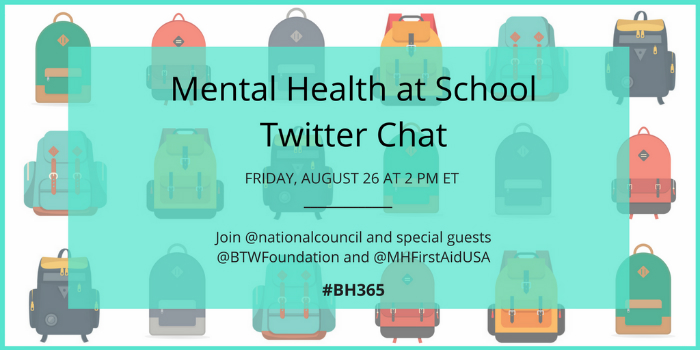
Today’s guest blog comes from our partners at the National Council for Behavioral Health. They’re dedicated to ensuring that adults and children living with mental illnesses and addiction disorders get the treatment they need. And Mental Health First Aid has trained 660,000 people to connect youth and adults in need to mental health and addictions care in their communities. On Friday, August 26 at 2 p.m. ET, we’ll be cohosting a Twitter chat on “Mental Health at School”. Join the conversation by using #BH365. We hope to see you there! 

image001

It’s the night before the first day of school. You’re a teacher and scrambling to make sure your classroom is stocked with the tools your students need to be successful this year: markers, rulers, flip charts, glue sticks—the list goes on. But what’s in your mental health toolkit?

According to the National Alliance on Mental Illness, one in five young people ages 13-18 have, or will have, a serious mental illness in their life, and half of all lifetime cases of mental illness start by age 14. Unaddressed mental health concerns in young people can affect every aspect of their lives—from relationships with classmates to performance in school—and teachers are in a unique position to notice and intervene when a student may be struggling.

Programs like Youth Mental Health First Aid equip teachers, parents and caregivers with the skills they need to identify and reach out to a young person who may be experiencing a mental health or substance use problem.

Here are 4 tools you can use to boost mental health at school:

1. Know the signs. Youth have unique risk factors for mental health problems, especially when you consider today’s often highly-competitive, stressful school environment. Knowing what signs to look for—like withdrawing from friends, dramatically increased or decreased appetite or acting out uncharacteristically—can help you know when you may need to offer support to a student.

2. Know how to start a conversation. Though more people are now talking openly about mental health, stigma is pervasive and can make having conversations about mental health tough—especially for young people. Being genuine is a good place to start. If this is an uncomfortable topic for you, saying something like, “This is hard for me to talk about, and maybe it’s difficult for you too,” can be a good way to start the conversation. Additionally, talking to an LGBTIQ student about their mental health requires an understanding of that person’s unique experiences. Familiarizing yourself with LGBTIQ culture, language and resources can help you better support the mental health needs of LGBTIQ students

3. Know what resources are available. Does your school have a mental health counselor? Is it appropriate to involve parents or other caregivers? Are there support groups in the area that might be helpful? Know what resources are available in your school and community so you can be prepared to offer information to a student who needs it. Being able to provide a young person with information on what help is available can be an invaluable tool

4. Take care of yourself. “You can’t serve from an empty vessel.” The act of providing support to others can sometimes leave you feeling worn out, frustrated or even angry. Taking the time to do things for yourself—like taking a walk, doing some breathing exercises or venting to an understanding friend—will help you stay healthy, happy and in a better frame of mind to care for others.

Young people can face a variety of mental health conditions and knowing how to recognize and provide assistance tailored to the individual’s needs is important. To learn more about how to support students’ mental health, register for a Youth Mental Health First Aid course near you (look for the courses with the purple “Youth” icon).

On Friday, August 26 at 2 p.m. ET, Mental Health First Aid USA and Born This Way Foundation will join the National Council for Behavioral Health for a “Mental Health at School” Twitter chat. Join the chat to learn more about the importance of mental health at school. To participate, follow @MHFirstAidUSA, @BTWFoundation and @nationalcouncil on Twitter and use the hashtag #BH365 in your responses.

twitter-chat-resized

Welcome To Our New Research Advisory Board

We are excited to announce the selection of five leading academics and researchers to join the Born This Way Foundation’s Research Advisory Board. The incoming board members are experts in issues related to youth wellness and mental health, social and emotional learning, and bullying. The Board guides the Foundation’s research-related initiatives and helps to ensure all of the organization’s programming is grounded in the latest scientific understanding. Dr. Susan M. Swearer, PhD of the University of Nebraska-Lincoln will continue to serve as Chair of the Research Advisory Board and Dr. Dewey Cornell, PhD will also return as a Board Member.

“We are thrilled to welcome these new additions to our Research Advisory Board,” said Cynthia Germanotta, President and Co-Founder of Born This Way Foundation. “Our organization is dedicated to empowering young people to live healthy, vibrant lives and we understand that doing so requires a firm basis in quality research. These men and women are leading experts in their fields whose collective decades of experience will help to guide Born This Way Foundation in accomplishing its mission of building a kinder, braver world.”

So, who are these new researchers? Here’s a little more information!

Dr. Susan M. Swearer, PhD is the Willa Cather Professor of Educational Psychology and a Professor of School Psychology at the University of Nebraska – Lincoln. She is the co-director of the Bullying Research Network and Director of the Empowerment Initiative. For over the past decade, Dr. Swearer has developed and implemented a data-based decision-making model for responding to bullying among school-aged youth and has conducted staff trainings in elementary, middle, and high schools, and higher education settings with the goal of helping to establish cost-effective and data-based strategies to reduce bullying behaviors.

Dr. Marla R. Brassard, PhD, is Professor and Director of Clinical Training for the APA-Approved PhD School Psychology Program at Teachers College, Columbia University. For over 30 years her research and advocacy have focused on psychological maltreatment of children by parents, teachers, and peers – its assessment, the emotional/behavioral injuries that result, contextual factors that moderate the effect of maltreatment, prevention/treatment, and how schools and child welfare agencies, by embracing a child rights approach, can prevent violence and neglect before it occurs by valuing all children and creating environments and communities that promote their full development.

Dr. Dewey Cornell, PhD, is a forensic clinical psychologist and Professor of Education in the Curry School of Education at the University of Virginia. He joined the faculty of the University of Virginia in 1986 and has studied youth violence for nearly 30 years. As a researcher, Dr. Cornell has conducted studies of youth violence, psychopathology, giftedness, bullying, and school safety.

Dr. Shelley Hymel, PhD, is the Lando Professor in Social and Emotional Learning through which she has established a Masters program concentration as well as a teacher training specialization in social-emotional learning. She serves on research advisory boards for the interdisciplinary Human Early Learning Partnership at UBC, aimed at optimizing child development through research, the Life Synergy for Youth program of Calgary, AB, and the Committee for Children in Seattle, WA. She is team leader for PREVNet, a Canadian national organization for “Promoting Relationships and Eliminating Violence,” and on the Board of Directors for the BC Crisis Intervention and Suicide Prevention Centre in Vancouver.

Dr. Michael Shore, Ph.D. is currently Vice President and Head of Global Consumer Insights and Foresights at Mattel, responsible for research on all Mattel brands including American Girl and Fisher Price. Over the past 20 years, Dr. Shore established Mattel’s global research infrastructure and has had responsibility for investigating kids’, parents’ and adults’ attitudes towards leisure time and play across all categories and platforms including entertainment, traditional toys, digital/video gaming, robotics, sports and emerging connected toy platforms. Dr. Shore is internationally recognized as one of the foremost industry experts on play behavior and toy preferences.

Dr. Brian H. Smith, PhD, is a Research Scientist at the Committee for Children where he translates and synthesizes research from a wide range of fields to inform the development and evaluation of school-based social emotional learning and bullying prevention programs. Dr. Smith received his doctorate from the School of Social Work at the University of Washington where his research focused on the science behind effective interventions to promote youth development and prevent youth problems. Prior to that he spent 9 years working as a counselor and social worker in K-12 schools and providing substance abuse and mental health counseling to teens.

Dr. Elliot Tebbe, Ph.D. is an Assistant Professor in the Counseling Psychology program at the University of Nebraska-Lincoln. His research interests focus primarily on the health and well-being of sexual and gender minority individuals and communities. Dr. Tebbe is particularly interested in exploring the role of positive identity in increasing well-being and attenuating distress. In addition to his research activities, he has served in leadership roles for several organizations including the American Psychological Association of Graduate Students (APAGS) Committee on Lesbian, Gay, Bisexual, and Transgender Concerns (CLGBTC) and is now President-Elect of Section IV (Lesbian, Bisexual, and Transgender Concerns) of Division 35 (Society of the Psychology of Women) of APA.

We are so excited to welcome these new members to the Born This Way Foundation team. We can’t wait to work with them to create a kinder, braver world. What research would you like to learn more about? Tell us in the comments.

The Power of Bystander Intervention in Bullying

How you react to a bullying situation can make a big difference, whether you’re directly involved, or you’ve just observed someone being bullied. Bystanders are those who watch bullying happen or hear about it and don’t take action. Actually, over 80% of students have been a bystander to bullying at school (Masters, 2016). As a bystander, you have the power to address the situation before it escalates.

Below are some tips on how to positively intervene when you see someone getting bullied:

  • Ask a trusted adult for help
  • Asking the bully to stop
  • Don’t give bullying an audience
  • Do not respond aggressively
  • Follow up with the person who was targeted

Recently published research shows that although comprehensive, school-wide programs including bystander components are effective in reducing bullying (Bradshaw, 2015; Polanin et al., 2012), many schools do not have the resources to implement time-intensive, multi-component programs (Midget, Doumas, Sears, Lundquist, Hausheer 2015). Here are some resources for students, parents, and educators on the topics of bullying and bystander intervention. It is important to consider the community of positive support that students and other adults can build to help prevent bullying. Currently, all 50 states in the US have laws governing bullying that require school personnel (administrators, teachers, and staff) to take action to intervene and protect students (Stopbullying.gov, 2015). That is why we encourage you to reach out to a trusted adult and ask for help.

It takes courage for someone to take action and intervene when they see or hear another person being bullied, but no matter how difficult it may be, research has found that schools and classrooms with greater rates of bystanders defending victims have lower rates of bullying (Jones, Mitchell, Turner 2015). So remember to be kind, brave, and empower your peers to make a positive influence in your schools and communities.

If you’d like to share your story about bullying intervention and the positive outcomes you’ve seen at your school we invite you to write to us here.

References:
Eyes on Bullying. (n.d.). Retrieved July 28, 2016, from http://www.eyesonbullying.org/bystander.html

Jones, L. M., Mitchell, K. J., & Turner, H. A. (2015, August 28). Victim Reports of Bystander Reactions to In-Person and Online Peer Harassment: A National Survey of Adolescents. Retrieved from http://www.unh.edu/ccrc/pdf/jones-bystander.pdf

Masters, Lyndsay, “Should I Stand By or Stand Up? Differences in Bullying Bystander Decision Making” (2016). Electronic Thesis and Dissertation Repository. Paper 3657. http://ir.lib.uwo.ca/etd/3657

Midget, A., Doumas, D., Sears, D., Lundquist, A., & Hausheer, R. (2015). A Bystander Bullying Psychoeducation Program With Middle School Students: A Preliminary Report. The Professional Counselor, 5(4), 486-500. Retrieved from
http://tpcjournal.nbcc.org/wp-content/uploads/2015/12/Pages_486-500.pdf

ReachOut.com. (n.d.). Retrieved August 09, 2016, from http://us.reachout.com/facts/factsheet/bystanders-role-in-bullying

Should I Stand By or Stand Up? Differences in Bullying Bystander Decision Making. (n.d.). Retrieved August 01, 2016, from http://ir.lib.uwo.ca/etd/3657/

5 Ways to Help Someone in a Mental Health Crisis

Helping a friend, family member, or even a stranger in need can be one of the most gratifying and confusing things to do.

Today, as a survivor of a mental health crises and mental health problems, I’m talking about the top five ways to help someone who is having a mental health crisis.

But first, what is a mental health crisis? Mentalhealthcrisis.org defines it as when a person “is in a state of mind in which they are unable to cope with and adjust to the recurrent stresses of everyday living in a functional, safe way.” Some signs of this are irritability, social withdrawal, anxiety, fatigue, extreme mood swings, abnormal sleeping/eating habits, the list goes on. But keep in mind that not everyone who goes through a mental crisis exhibits all of the traditional symptoms. They may experience only a few or all of the symptoms or fall somewhere in the middle.

So with that, here’s what you can do to help.

  1. UNDERSTAND THAT YOU DON’T UNDERSTAND.Even if you have been in a mental health crisis everyone goes through a different kind of crisis. Mental health crises are like well made suits, they are tailored to the individual, they are not one size fits all. Most of us know what it’s like for someone to say they totally get your problem while you sit there screaming inside your head “NO YOU DON’T!!!!!!” So be empathetic, be sympathetic, listen and really hear your loved one but realize that there’s no way you can truly know what’s going on inside their mind because you are not in their head. Simply put, be the person they can talk to and the shoulder they can cry on, not the person who tells them what to do.
  2. KEEP CONTACT AT ALL TIMES. If you feel that someone is a threat to themselves (such as having violent and/or suicidal thoughts and actions) or others always have a way to be reached in case they need to talk to you. Also, check in on them regularly whether it be in person or just sending them a text saying “Hey, just writing to say hi.”
  3. CREATE A NETWORK OF HELPFUL PEOPLE. This ties in with the point above. Don’t be the only person with the responsibility of taking care of a loved one. You’ll overwhelm yourself very quickly and it’s hard to help others when you are not at your best. It’s like on airplanes when they say to put your own oxygen mask before helping others. Get a group of friends and/or family members that the loved one you’re helping trusts. Give them multiple people to contact and let them know that they are surrounded by people who care.
  4. NEVER HESITATE TO GET PROFESSIONAL HELP. Even if it is against the wishes of the one you are helping call 911 if you think they are in danger. They may be angry and threaten to not be friends anymore, but if the situation is no longer something you can handle then you’re number one job is to ensure the safety of your loved one and get them the help they need even if they don’t want it.
  5. IT’S NOT YOUR FAULT! As someone who has helped others through mental crises (not to mention having my own mental crises) you do not have a magic wand that you can wave to fix everything. What you do have is your support, love, compassion and understanding but sometimes these don’t feel like they are enough. It can feel hopeless at times but KEEP GOING! Mental health crises can’t be cured overnight so don’t beat yourself up for not getting instant results.

If you have any more questions on helping those in a mental health crisis, you can call the National Suicide Prevention Hotline at 1-800-273-8255 and they can refer you to help in your area. And, you can find more resources here: https://bornthisway.foundation/get-help-now/