MANAGE YOUR COOKIE PREFERENCES

We use necessary cookies to make our site work and to give you the best possible experience. If you are happy for us to do so, we would also like to set optional analytics cookies to help us improve this site by collecting and reporting information on how you use it. We won’t set these optional analytics cookies unless you tell us it is OK to do so using the tick box below.

For more information on how any of our cookies work, please refer to our privacy policy.

6 Steps to Supporting a Survivor

April is Sexual Assault Awareness Month. As part of SAAM, Born This Way Foundation is posting a series of guest blogs from sexual assault survivors and awareness and prevention advocates. We want to ignite the conversation around sexual assault and end it. Today, we’re featuring a guest post by Monica Martinez, Director of Retreat Research & Survivor Support for the Joyful Heart Foundation, a national organization founded by actress and advocate Mariska Hargitay that works to heal, educate and empower survivors of sexual assault, domestic violence and child abuse, and to shed light into the darkness that surrounds these issues. To learn more about Joyful Heart and these issues, visit www.joyfulheartfoundation.org

It takes courage for a survivor to share their story with anyone. As one survivor shared with us once about her own experience, “It’s not just what happened that night. It’s everything that happened after.”

In listening to an individual’s story, your response can have an enormous impact on that person’s healing journey. There are words, actions and resources that can help you support someone who shares their personal experiences with you. Although you can never take away what happened to someone, you can be a source of comfort.

Just remember, if someone shares their story with you, that means you’re probably already a person they look to for support, compassion and guidance. You don’t have to be an expert—you just have to be yourself.

1. Listen. 

Sometimes you don’t even need words (or at least, a lot of words), to be there for someone. Many people share that just being able to tell their story to someone else lessens the weight of isolation, secrecy and self-blame. Remember, listening in and of itself is an act of love

2. Validate.

Think about a time when you felt vulnerable or faced a crisis, and think of what helped you the most. Chances are that it was not a specific conversation that you had, but it was the knowledge and comfort the person or people you told were there for you, believed in you, were on your side and were committed to supporting you through a hard time.

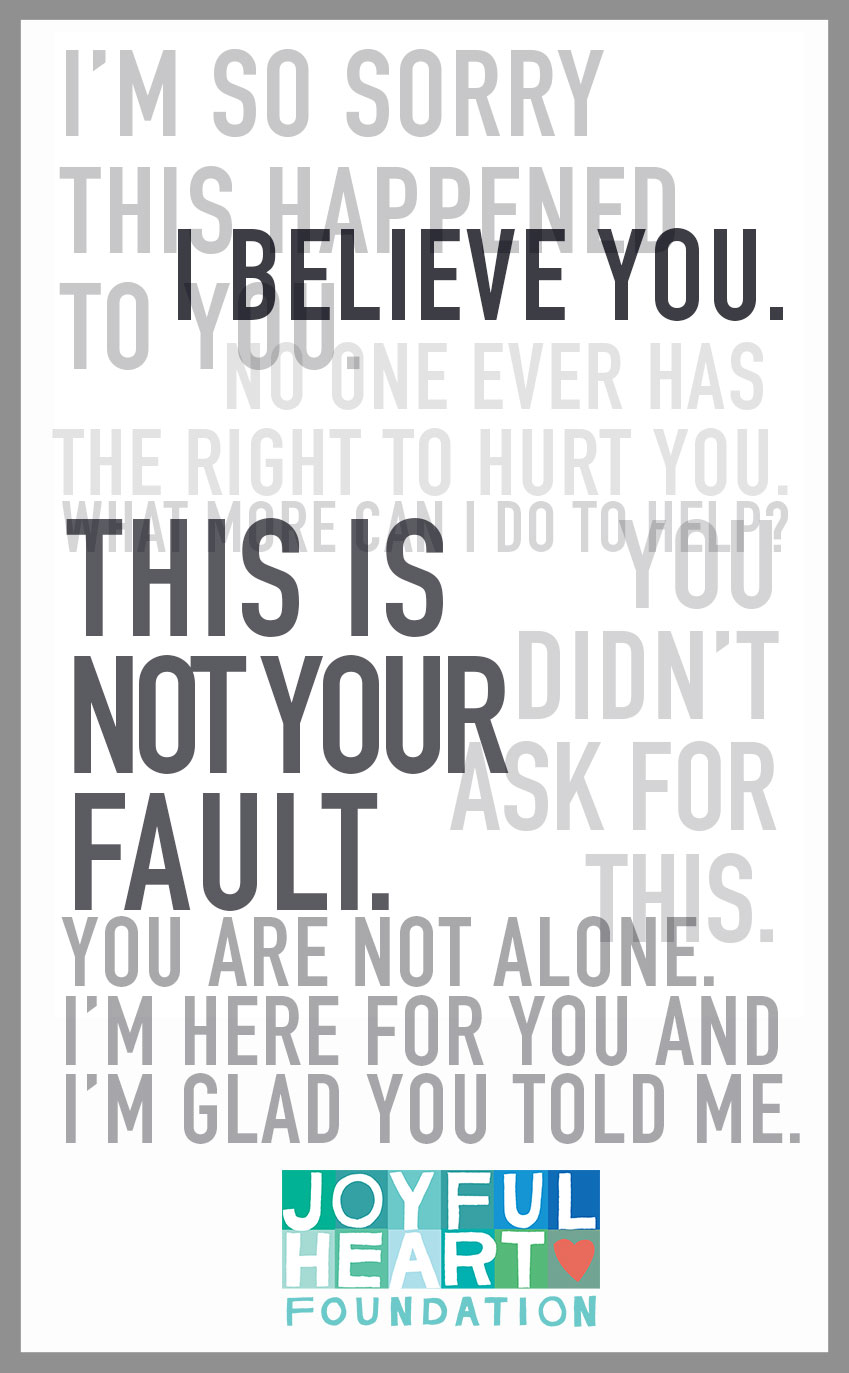
“I’m so sorry this happened to you.”

“I believe you.”

“This is not your fault.”

“You’re not alone. I’m here for you and I’m glad you told me.”

Often times, a survivor may feel like what happened to them is their fault. We are bombarded with victim-blaming myths and attitudes in our society, and they can sink in…deeply. But no action excuses a person hurting someone else. Violence and abuse is never the victim’s fault. That responsibility and shame lies with the perpetrator. It can be helpful to communicate that gently and repeatedly.

“Nothing you did or could’ve done differently makes this your fault.”

“The responsibility is on the person who hurt you.”

“No one ever has the right to hurt you.”

“I promise, you didn’t ask for this.”

“I know that it can feel like you did something wrong, but you didn’t.”

“It doesn’t matter if you did or didn’t _______. No one asks to be hurt in this way.”

3. Ask what more you can do to help.

Violence and abuse is about power and control. It is vital for survivors to regain their sense of personal power and agency. Instead of pushing someone into taking actions for which they are not ready, ask how you can support them.

4. Know where to point someone to for more help.

You can best help the survivor by offering options and leaving space for them to decide where to go from there. Here are some national resources—services that can point someone to local resources in your area. The Joyful Heart Foundation has resources and information on our website for survivors and friends, family and partners. Learn more about them here.

5. Keep an open heart.

Remind them that you are available should they like to talk about their experiences further. The healing journey can be a long one, full of many challenging—but sometimes joyful and liberating—conversations. Knowing that you are there to support along the way can make a big difference for someone.

“If we are able to communicate only one thing about your role in a survivor’s journey, it is this: never ever underestimate your power to affect its course.” 

– Maile Zambuto, Joyful Heart CEO

6. Finally, care for yourself.

There is a limit to what we are able to take in and process. The stories of someone else’s hardships related to a traumatic event can impact or become a part of us. This experience of second-hand trauma—often called vicarious trauma—is a human response to coming face-to-face with the reality of trauma and the difficulties of the human experience.

It’s important to care for yourself as you support another person. You cannot be your best self in your supportive role if you find yourself too tired to listen with care and compassion, or overfilled with your own emotions in response to another’s trauma. These feelings are totally valid. Take some time after a conversation to enjoy the outdoors, or do a healthy activity that makes you feel good as a way of re-centering yourself. We have more ideas on how to mitigate vicarious trauma here.

Remember, you can be your best self for someone else when you give yourself the space to honor your own needs.

To get more content like this, and to receive updates from the Joyful Heart Foundation, sign up here.

This blog post originally appeared on the Joyful Heart Foundation website. It has been reposted here with permission.
#BeKindBakeOn Semi-Finalists Revealed!

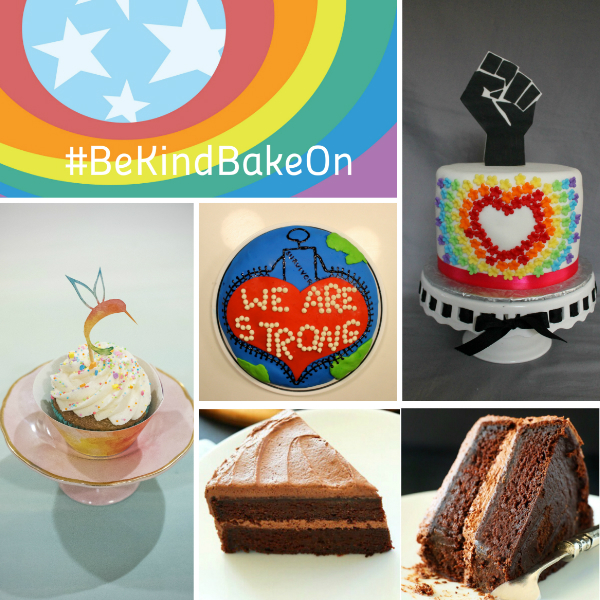
It’s finally time to reveal the semi-finalists in our Kindness Cake Bake Off. This contest brought together the kindest and bravest bakers and cakes. Thank you to everyone who entered and thank you for voting!

The race was almost too close to call but we are thrilled to announce our four semi-finalists, Stephanie, Allison, Em, and Sabrina.

Next Chef Travis will bake all these delicious cakes at Joanne’s Trattoria. Our co-founder Cynthia Germanotta and a soon-to-be-revealed panel of special judges will taste the cakes and decide the winners in both Recipe and Design.

Which cakes will be elected the Kindness Cakes of 2016? Stay tuned for news about our judges, the final taste test, and the final announcement! And follow us on social, @BTWFoundation, and Born This Way Foundation so you don’t miss out.

BTWF Kindess Cake SemiFinalists


#KindMonsters

We’ve teamed up with Monster High to show that being a monster isn’t always a bad thing. In fact, being a monster can be awesome! Thousands of people signed our pledge and promised to practice kindness every day. We’re excited to work with Monster High to inspire change and help create a kinder, more accepting world!

Partnering to promote kindness and acceptance, we also launched Zomby Gaga – a Monster High doll!

MH_BTWFPledgeWall_ToyFair_Final (1)


We also heard about hundreds of #KindMonsters around the country who are leaders in their communities and schools. Here are some of our past winners:


#ThatsNotLove

April is Sexual Assault Awareness Month. As part of SAAM, Born This Way Foundation is posting a series of guest blogs from sexual assault survivors and awareness and prevention advocates. We want to ignite the conversation around sexual assault and end it. Today’s guest blog comes from the One Love Foundation. One Love was established by the Love family, after the loss of their daughter to relationship abuse. Find out more about the One Love Foundation on Relationship Abuse and join the movement to end relationship abuse because #ThatsNotLove.

Trigger Warning: This post contains descriptions of sexual assault. If you are in immediate danger, please call 911. Please call 800-656-4673 if you would like to speak with the National Sexual Assault Hotline or connect with their online hotline here.

2016-04-21_1001

There’s no better feeling than when you’re starting a new relationship. In the beginning, everything about that person and the relationship seem great – you soak up every small encounter, whether that be a walk to class or a giggle over an inside joke. You’re excited to be wanted so much and you crave to be with that person every minute of every day. When you’re apart, songs remind you of that person, and you can’t wait to be back together. It’s all just so good.

It’s easy to get caught up in the moment and get swept away with how wonderful it feels. But then you begin to realize that things are not as perfect as they originally seemed. It starts to feel like you need to work harder at your relationship, and your partner increasingly gets angry or jealous. Next thing you know you’re being told what to do, who to talk to, or what to wear. You’re criticized for little things and you’re constantly switching between feeling mistreated and feeling crazy. Still, you push these feelings under the rug since they are usually quickly followed with apologies of “It’s just because I love you so much” or “I’m sorry, it will never happen again.” You tell yourself that the person needs you – they confide in you and rationalize their behavior with personal secrets. Apologies lead you to get over it, minimize the hurt, and believe that these were one time problems, issues that all couples experience.  After all, your partner loves you so much and you have so much fun together – well, most of the time.

Looking back, it’s easy to see that all of these signs characterize an emotionally unhealthy relationship.  But in the moment, it’s hard to see that these behaviors are unhealthy and can ultimately be very dangerous. Unhealthy and destructive relationships don’t start out with abuse, they start the same way any good relationship does. The truth is that 1 in 3 women and 1 in 4 men will be in some form of a violent relationship in their lifetime. What’s worse is that young women between the ages of 16 to 24 experience the highest rate of relationship abuse. You might read this and think, “Well, they never actually hit me.” But physically abusive relationships normally start out with emotional abuse, and that’s why it’s so important to educate yourself about the warning signs of an unhealthy relationship. Whether it’s mental or physical, abuse is real and it’s a big problem in our society.

Yeardley’s Story

Such is the story of Yeardley Love, a 22-year-old student athlete at the University of Virginia. Popular, smart, funny, and confident are the words used to describe Yeardley. Everyone who knew her loved her, and Yeardley was the last person you’d think could be in an abusive relationship.  What her friends and family (and likely Yeardley herself) didn’t know is that Yeardley was in an unhealthy and dangerous relationship with her on-again off-again boyfriend, George Huguely. Just three weeks before their graduation, on May 3, 2010, George broke down the door to her room and beat Yeardley to death.

After her death, Yeardley’s family and friends learned about relationship abuse and realized that there were red flags that they should have seen in Yeardley and her relationship.  They ultimately believed that her death could have been avoided if they were better informed about the warning signs and the risks of an unhealthy relationship.  That’s why the One Love Foundation, an organization started by Yeardley’s mom, Sharon Love, has made it their mission to educate young people on the subject of relationship violence and empower them to stop it in their communities.  At One Love, we focus on teaching young people about the unhealthy behaviors that can become dangerous and abusive. We hope to raise awareness so that the earliest signs are recognizable and actionable. One Love firmly believe that with more awareness, lives will be saved.

How we do it: The Escalation Workshop and Team One Love

Today, One Love has a team of students and young people who run Escalation Workshops in campus communities across the country. Escalation is a film about two college-aged young people embarking on a new relationship which quickly moves from exciting to abusive.  After viewing the film, students split into small groups to discuss scenes in the film and how the story could have played out differently if the main characters, or their friends, had better understood the signs they were seeing. To date, Escalation has been brought to over 550 school campuses and counting, with over 35,000 students participating in just 15 months. On many of these campuses, students create a Team One Love club that works to continue spreading the word about the signs of relationship abuse and its prevalence. If you want to know if there’s a Team One Love at your school, go to www.joinonelove.org/movement OR bring it to your school by dropping us a line on our contact form.

#ThatsNotLove

Young people are also using #ThatsNotLove to educate those around them about the warning signs of abusive relationships. #ThatsNotLove is a campaign created by One Love to help people understand the difference between what’s healthy and what isn’t in a relationship. It consists of mini videos that you can share on social media with the #ThatsNotLove hashtag to get people thinking about what unhealthy relationship behaviors look like. One chapter of #ThatsNotLove is “Because I Love You,” which you can watch below:

The difference between love and control can sometimes be a little fuzzy, but the signs are much clearer once you know them. #ThatsNotLove aims to help everyone better understand what abuse is and the different forms it can take. Whether it’s an overly controlling girlfriend, or a super jealous boyfriend who gets angry when you talk to other guys – abuse doesn’t always come with bruises and that’s when it’s harder to spot.

So what should I do?

If you or someone you know is in an abusive or unhealthy relationship, you need to seek help right away. JoinOneLove.org has resources to help you figure out if you are in an abusive relationship and where you can get the support you need. Sometimes it’s hard to understand that your relationship might not be healthy, but there is a community of people who are always here to help.

The sad truth is that we’ve all seen forms of relationship abuse, we just might not have known it at the time. But that’s why it’s so important to educate yourself and spread the message. Relationship abuse is preventable if you know the signs, and with a little help from the Born This Way Foundation and One Love, we can all work to end relationship abuse together.

Want to see more from #ThatsNotLove? You can watch all the video clips on www.joinonelove.org/campaigns or follow us on Instagram, Twitter, and Snapchat at @Join1Love.

Meet A Survivor Re-Defining Justice and the Nonprofit Helping Her Do It

April is Sexual Assault Awareness Month. As part of SAAM, Born This Way Foundation is posting a series of guest blogs from sexual assault survivors and awareness and prevention advocates. We want to ignite the conversation around sexual assault and end it. Today’s guest blog comes from the Network for Victim Recovery of DC (NVRDC). The NVRDC was established in 2012 to provide a seamless network of referrals and services to all crime victims.  

Trigger Warning: This post contains descriptions of sexual assault. If you are in immediate danger, please call 911. Please call 800-656-4673 if you would like to speak with the National Sexual Assault Hotline or connect with their online hotline here.

2016-04-15_1436

Laurel [1] had waited more than a year for this moment. It was almost two years since she went to a concert with friends, took a drink that someone offered her, and woke up the next morning in a blood stained bed with vomit on her pillows and no clear memory of what had happened. It was with shock, horror, and panic that she realized she was raped. After receiving an invasive medical forensic exam, filing a police report, telling and re-telling her story to strangers over and over, and after months of waiting, she was finally here. Now, sitting in a room with her victims’ rights attorney, the detective assigned to her case, and the Assistant U.S. Attorney who would decide the outcome of the investigation—she was ready to hear the decision. Her assailant had originally told police that he didn’t have sex with Laurel but then, after being told that his semen was found in the Sexual Assault Nurse Examiner (SANE) kit, changed his story to say that the two had sex but that it was consensual. But Laurel would never know what a judge or jury would have to say about this change in his testimony or anything else, because at this meeting she was told that her case would not be prosecuted due to lack of evidence. Her assailant would face no consequences in the criminal justice system.

Sadly, Laurel’s story is not unique. According to RAINN, only 32% of rapes even get reported to law enforcement. Only 3% are referred to prosecutors, and only 2% ever lead to a felony conviction.[2] Societal misconceptions and rape myths perpetuate the challenges that survivors face while going through the criminal legal process. Questions like “How much did you drink?” and “Why did you let them into your home?” perpetuate the fact that many people still see survivors as at least partially responsible for what happened to them.

It took Laurel two months to decide whether or not she was ready to report the assault to law enforcement. Going into it, she knew that the chances of her case being prosecuted, let alone of getting a conviction, were very small. Even though the kit contained evidence that clearly showed that they had sex, Laurel’s victims rights’ attorney told her that even with evidence many cases never go to trial. Despite the fact that she knew reporting would force her to tell and retell the story of her assault to strangers who may not believe her, ultimately she decided that she needed to take a stand for herself and for other survivors. It took one meeting for her hopes for a day in court to be washed away.

Wraparound support for survivors

Laurel is one of hundreds of survivors NVRDC has met since first opening their doors in 2012. Their mission is to empower victims[3] of all crimes to achieve survivor defined justice through a collaborative continuum of advocacy, case management, and legal services. NVRDC first intersected Laurel when she went to MedStar Washington Hospital Center to receive her medical forensic exam following her assault. One of NVRDC’s case managers stayed with her the whole time to provide emotional support and to give her information about the choices available to her after the exam. Laurel’s case manager connected her with one of NVRDC’s attorneys who gave her legal advice and assisted her with reporting and with the investigation process. Her NVRDC attorney was the one sitting beside her when the prosecutor told her that her case was not going to move forward.

One of the things that makes NVRDC unique among other service providers is the fact that they provide comprehensive and wraparound services regardless of race, ethnicity, gender identity, sexuality, religious affiliation, income-level, or immigration status for as long as they’re needed. Oftentimes survivors need to go to one organization for hospital accompaniment and case management, another to find a lawyer for assistance filing for a civil protection or restraining order, and yet another for legal representation during the criminal investigation and prosecution. In many places around the country, survivors do not even have access to organizations in their area that provide crime victims’ rights representation.

NVRDC’s vertical advocacy model ensures that the same case manager who a survivor meets at the hospital during their exam remains their case manager for as long as they are needed in the survivor’s recovery. It also allows their clients to connect with a single attorney who can guide them through all aspects of the legal system. Research has shown that rape survivors who receive the assistance of an advocate were significantly more likely to have police reports taken when reporting the crime to law enforcement and were less likely to be treated negatively by police officers. These survivors also report experiencing less distress during their involvement with the legal system. This is especially pertinent given the fact that sexual assault survivors are more likely than others to experience negative social consequences. They are three times more likely to suffer from depression, 13 times more likely to abuse alcohol, 26 times more likely to abuse drugs, and four times more likely to contemplate suicide.[4] Research has also shown that crime survivors who receive wraparound supportive services report greater satisfaction with their experience in the justice system regardless of the outcome of the case.[5] What NVRDC believes is that even though there are many aspects of the justice system that are ultimately out of a survivor’s control—including whether or not the case against their assailant will be brought to trial—providing comprehensive supportive services for victims will reduce the likelihood of retraumatization and help survivors feel more empowered throughout the process, regardless of the outcome.

Survivor defined justice

Laurel describes receiving the decision from the prosecutor as one of the most hurtful things that she has ever experienced. When the doors to achieving justice through a criminal trial were closed to her, she created new openings for herself. She drew upon her frustrations with her own experience to tirelessly advocate for other survivors of sexual violence in the District. Thanks, in large part to her advocacy, in 2014 the DC Council enacted legislation that expanded the rights of sexual assault survivors in the District called the Sexual Assault Victims’ Rights Act Amendment (SAVRAA). Provisions of this legislation such as making SANE kit results available to victims, ensuring those results were returned in a timely manner, having the right to know the results of the exam, and requiring law enforcement to notify the survivor of when they are going to contact the accused assailant were included because of Laurel’s advocacy and the testimony she shared about her experiences following the assault.

Since SAVRAA went into effect in the fall of 2014, Laurel has served as a member of the DC SAVRAA Task Force (a multidisciplinary task force that convenes to address the issues that arose from the passage of SAVRAA) and has continued to advocate for greater transparency in criminal prosecutions and for stronger protections on behalf of survivors. Laurel was acknowledged for her efforts by the Office of Victims of Crime, a component of the Office of Justice Programs, U.S. Department of Justice, in 2015 when she was awarded the Crime Victims’ Rights Award. In honor of her legacy, NVRDC named the Laurel Advocacy Award after her, which recognizes a community partner who demonstrates a commitment to working closely with the community and with NVRDC to further the needs of those impacted by crime.

Looking back on these experiences, Laurel said, “This entire process has taught me that I am so much bigger than any fear that I’ve ever had. We don’t ask to be victims, but we do have the power to stand up for what we believe in.” Survivors across the country are standing up and advocating for changes in how institutions and systems respond to sexual assault. Moments like when Lady Gaga sang “Till It Happens to You” with 50 survivors standing with her on stage at the Oscars have served as a powerful microphone to amplify the voices of survivors like Laurel and countless others. NVRDC looks forward to the day that their services for victims of sexual assault aren’t needed anymore. But until the day comes when sexual violence in all its forms is eradicated, NVRDC is honored to work with survivors like Laurel and hundreds of others in working together to achieve what justice looks like to them.

Get Help

If you are in the District of Columbia and experienced a sexual assault, please call the DC SANE Hotline at 800-641-4028. If you have been the victim of a crime in DC and would like to speak with an advocate about case management and legal advocacy, you can visit www.nvrdc.org or call 202-742-1727.

If you live or were assaulted somewhere other than the District of Columbia, you can contact RAINN by calling 800-656-4673 or connect with their online hotline here.


[1] Personally identifying details about Laurel’s case have been left out to protect her privacy. This story is used with her permission.

[2] RAINN, Reporting rates, https://rainn.org/get-information/statistics/reporting-rates.

[3] While NVRDC supports however victims/survivors choose to identify themselves and their experiences, as an organization that provides legal representation, uses “victim” in the title as it is a legal term that provides survivors/victims with specific rights under laws such as the Crime Victims’ Rights Act. As seen in this article, NVRDC often uses both the terms victim and survivor to describe individuals who have been impacted by crime.

[4] RAINN, Effects of rape, https://rainn.org/get-information/statistics/sexual-assault-victims.

[5] Office for Victims of Crime, U.S. Department of Justice, Vision 21 Report, http://ovc.ncjrs.gov/vision21/pdfs/Vision21_Report.pdf